Tuesday, March 17, 2015

Peregrine Falcon in Wisconsin


The Latin word for the Peregrine is "peregrinus" which means "wanderer," no doubt because the Peregrine is found worldwide except in Antarctica.  Another name for the Peregrine is "Duck Hawk."

The Peregrine is about the size of a crow, weighs around 2 lbs. and has a wing span of 3 1/2 ft.  As with most predator birds, the female is larger. The most distinctive features of the Peregrine are its yellow eye-rings and yellow legs.

The Peregrine photos shown here were taken recently at the nesting box located atop the power plant in Port Washington, WI on the southeast side of the building. It can easily be seen from the parking lot located on the south side of the plant.
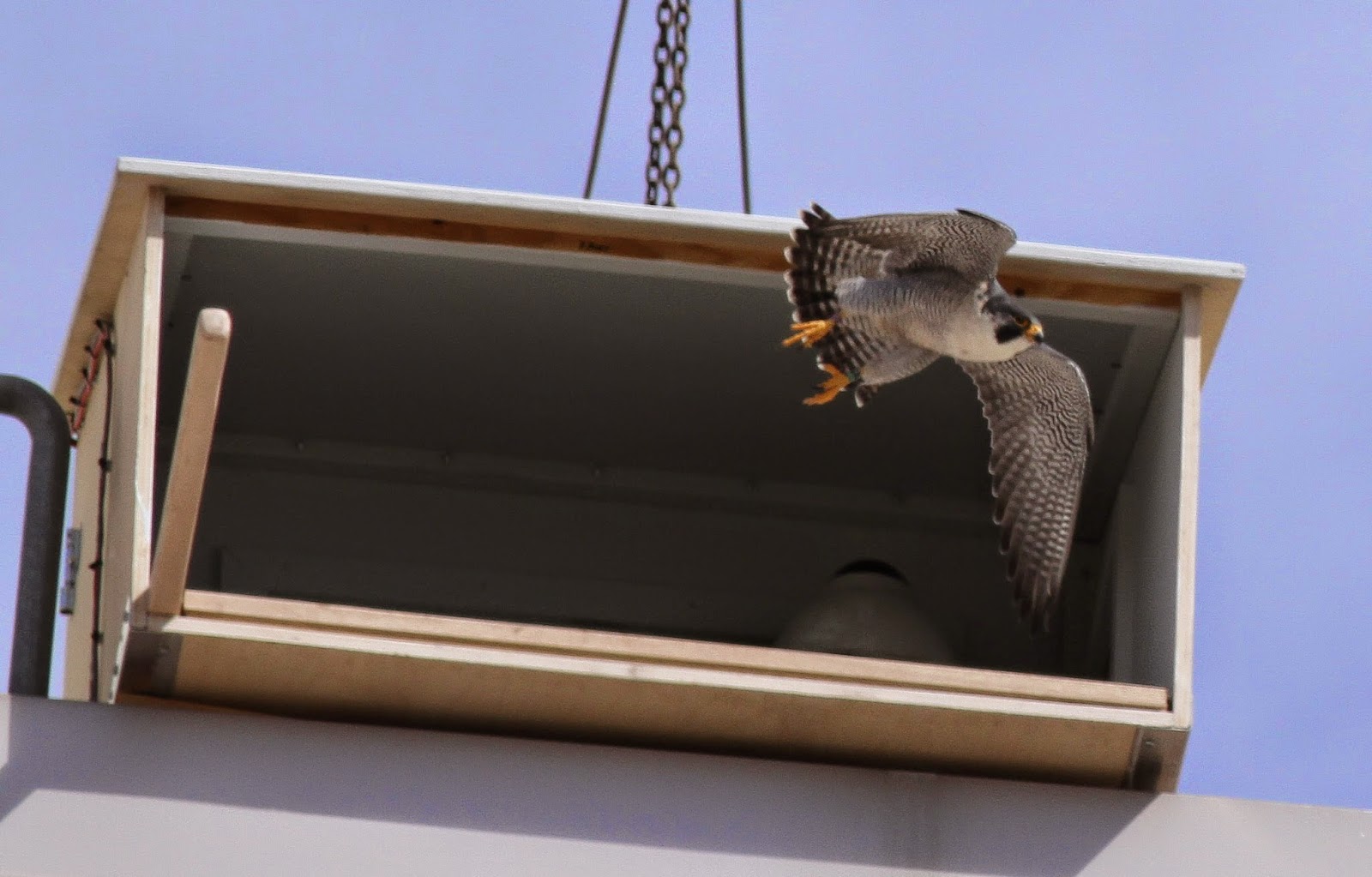


Note the bands on the legs of the bird in the photo above. Some research last year concluded that the Peregrines using this nesting box were originally tagged in Indiana.


When the Peregrine dives to catch its prey (birds, bats, ducks) it can reach a speed of 200 mph and is considered the fastest bird in the world.

I was lucky to photograph one of the Peregrines returning from a hunt with a small bird in its talons.


                                          From the looks of it, their dinner didn't fare well.
                                      Looks like the female took the lion's share and
                                   ran away.


WARNING!

Sexually explicit photo of bird sex follows. Send the kids to their rooms.


 Take my word for it...the above photo depicts our two birds having sex. They hid their passion well behind that pulley. Unfortunately, I wasn't able to get the shot of them sharing a cigarette afterwards.


In the mid 20th century, the Peregrine was almost eradicated because of the prevalence of  DDT but it has made a steady comeback since the pesticide was banned. Wisconsin is lucky to have this nesting box and others elsewhere in the state. Look for it the next time you visit Port Washington.


Saturday, December 20, 2014

Frozen Abstracts


Another Wisconsin morning without sunshine, no birds in sight, and I'm standing by the Thiensville dam, freezing. Ice is starting to form sporadically along much of the river banks but it is thin and irregular. 
 
One of the things I love about photography is that a seemingly plain subject can look totally different if you zoom in and redefine your composition in an unfamiliar way. All of the following photos are of patches of ice in a small stream that feeds into the river.
 
Disclaimer: Some of the photos were edited to change the exposures or tones in order to give them an abstract quality. 


Note: The photo on the left was edited to change image orientation from positive to negative.


Saturday, October 25, 2014

Hosta Luego! Goodbye, Autumn!

This has been a beautiful fall in Wisconsin, but sometimes we overlook the last stages of color in our gardens and landscapes. These photos were taken in gardens and landscapes just before the rain and wind accelerated their disappearance.


The camera doesn't capture the scene quite as faithfully as the human eye, but it can transform a common field into an impressionist display.


Behold the lowly hosta plants!


"Autumn is a second spring when every leaf is a flower."
 
~Albert Camus


You can still find spots in autumn that remind us of spring. 
 

“Fall has always been my favorite season. The time when everything bursts with its last beauty, as if nature had been saving up all year for the grand finale."
 
~Lauren DeStefano


Sunday, September 7, 2014

Red-Tailed Hawk


Sometimes you needn't look beyond your own backyard for excellent photo ops. This was the case last week when I spotted a Red-Tailed Hawk in the yard of a nearby neighbor. I was able to get this shot and considered myself lucky---hawks seldom stroll around the yard.


The next day, I saw the hawk in a tree a few hundred feet away, so I pulled into a neighbor's driveway for a better visual vantage point. The hawk seemed to be staring at me (or the lens) and, again, I felt very fortunate to have another chance at some good pics.

All of a sudden Red-Tail left the tree and flew directly toward me, finally landing atop the roof of the condo where I was parked! I couldn't believe my good luck, so I slowly lowered my window and got some of the best hawk photos ever.


After a few minutes, Red-Tail flew away, almost as though he/she finally decided that I wasn't lunch and that smaller prey would be easier to carry away than the voyeur with the camera.


A few in black & white:


Monday, July 28, 2014

Ospreys Redux

My friend Allan and I made another trip to Green Lake to check on the progress of the nesting ospreys there.  This was precipitated by a visit to the Green Lake Association Osprey Cam (http://www.greenlakeassociation.com/glaw/index.php/what-we-do/watershed-education/green-lake-osprey-cam/ ) where we noted that the two fledglings in the nest were quickly reaching a size where they would have a solo flight and then leave the nest for good.

Only one of the fledglings was visible from the ground.


Mama osprey began circling above us, sending out a distress call to hubby who, as usual, was nowhere around.


After about 30 minutes, Papa osprey appeared with lunch, a rather large fish, but he saw us and flew away, fish in talons.  Note the size of the fish.


After a few minutes, Papa returned with a slightly smaller fish. The bum had been snacking while he waited for us to leave! Once again, he flew off to his quiet corner somewhere.


The next time that he came back and refused to land, we deduced that if the fledglings were to be fed we would have to leave the area, so we moved a short distance away.


Success! He finally landed with what was left of the meal. (Photo taken from afar.)


If you think you might want to see the nesting ospreys, just go to the center of the city of Green Lake and find the high school baseball field; it won't be difficult to locate. But you'd better act quickly---the fledglings look as though they'll be taking off soon.


Saturday, June 7, 2014

Birds in Flight--Part 1


Birds in flight are always beautiful and sometimes scary.  From the lowly Black Tern to the awesome Bald Eagle, to the intimidating Osprey, there's nothing more spectacular than to see a bird in flight. Here are my favorites.


These graceful Ibises look like they're attached and choreographed but it's just business as usual when they fly.


 The snowy owl on right has feathers that give the owl a silent, stealthy approach to its prey, which hears nothing until it's too late.


No comment necessary.


The hawk on the right took off immediately when I invaded its personal space.
Kaukana, Wisconsin, Bald Eagle


Herons are stately when quietly wading in water but are also agile and graceful in flight.


These Canada Geese made a fast escape from our condo pond when I approached.
 
The Black Tern photos were taken a few weeks ago at Horicon Marsh.  They are quick and accurate as they dive for their food, but when they hover like this there's a good chance to get a decent photo. 


This Osprey photo was taken on May 28th in Green Lake, where a pair of Ospreys returned to a nest they built last year on top of a light fixture at the local baseball field.

As you can see, the Osprey can be very scary looking (but perfectly beautiful!)

BTW, there's a Green Lake Association Osprey Cam available on the net. Just Google for it and watch as they sit on their eggs.