Sunday, May 17, 2015

Moab, Utah

Moab, Utah, located in the southeastern quadrant of the state, is the perfect place to explore three of the most beautiful parks in the United States---Arches National Park, Canyonlands National Park, and Dead Horse Point State Park.

We recently spent eight unbelievable days doing just that, staying at the Red Cliffs Lodge near Moab and taking early morning and late afternoon trips to the parks in order to take advantage of the optimum light conditions.


The above photo was taken one early morning at Dead Horse Point State Park. This scenic view is one of the most photographed in the world.


We were hesitant to drive to the park during a light rainfall at sunrise but were rewarded by this spectacular sight.


The following shots reflect the changing landscape at Dead Horse Point. (Use Google to find out the origin of the name.)


Take a guess how Arches National Park got its name. There are over 2,000 natural arches within the park. Here are a few:


Balanced Rock in Arches Park is fascinating in the daytime and at night.  We were there during a full moon and it only took me about 100 tries before I got this "just okay" shot:


This is what it looks like at sunset: 


Other pics at Arches:


Canyonlands National Park is located near Dead Horse Point and also has wonderful scenic viewpoint as well as hiking trails. Mesa Arch is located there:


                                                                     (Above) Another Canyonlands viewpoint.                        


The Priest and the Nun formation (left) is not in any parks---just along one of the many highways near our resort, as is Fisher Tower (below), site of many a western movie location.


Final word:

I took over 1,000 photos during this trip. Unless you leave $10.00 in a duct-taped mayonnaise jar at my doorstep, I will send all of the photos for you to watch.
 

Tuesday, March 17, 2015

Peregrine Falcon in Wisconsin


The Latin word for the Peregrine is "peregrinus" which means "wanderer," no doubt because the Peregrine is found worldwide except in Antarctica.  Another name for the Peregrine is "Duck Hawk."

The Peregrine is about the size of a crow, weighs around 2 lbs. and has a wing span of 3 1/2 ft.  As with most predator birds, the female is larger. The most distinctive features of the Peregrine are its yellow eye-rings and yellow legs.

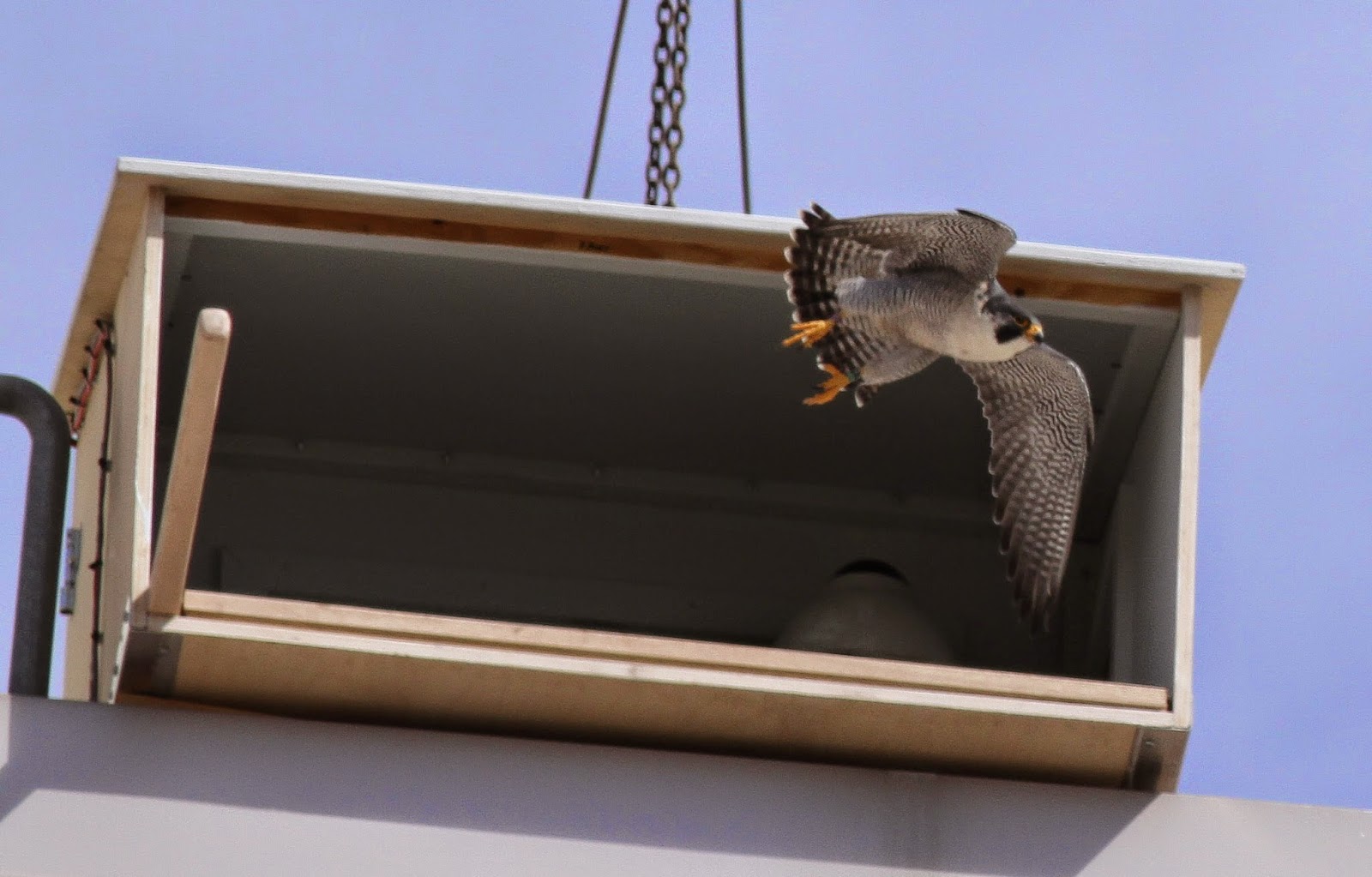
The Peregrine photos shown here were taken recently at the nesting box located atop the power plant in Port Washington, WI on the southeast side of the building. It can easily be seen from the parking lot located on the south side of the plant.


Note the bands on the legs of the bird in the photo above. Some research last year concluded that the Peregrines using this nesting box were originally tagged in Indiana.


When the Peregrine dives to catch its prey (birds, bats, ducks) it can reach a speed of 200 mph and is considered the fastest bird in the world.

I was lucky to photograph one of the Peregrines returning from a hunt with a small bird in its talons.


                                          From the looks of it, their dinner didn't fare well.
                                      Looks like the female took the lion's share and
                                   ran away.


WARNING!

Sexually explicit photo of bird sex follows. Send the kids to their rooms.


 Take my word for it...the above photo depicts our two birds having sex. They hid their passion well behind that pulley. Unfortunately, I wasn't able to get the shot of them sharing a cigarette afterwards.


In the mid 20th century, the Peregrine was almost eradicated because of the prevalence of  DDT but it has made a steady comeback since the pesticide was banned. Wisconsin is lucky to have this nesting box and others elsewhere in the state. Look for it the next time you visit Port Washington.


Saturday, December 20, 2014

Frozen Abstracts


Another Wisconsin morning without sunshine, no birds in sight, and I'm standing by the Thiensville dam, freezing. Ice is starting to form sporadically along much of the river banks but it is thin and irregular. 
 
One of the things I love about photography is that a seemingly plain subject can look totally different if you zoom in and redefine your composition in an unfamiliar way. All of the following photos are of patches of ice in a small stream that feeds into the river.
 
Disclaimer: Some of the photos were edited to change the exposures or tones in order to give them an abstract quality. 


Note: The photo on the left was edited to change image orientation from positive to negative.


Saturday, October 25, 2014

Hosta Luego! Goodbye, Autumn!

This has been a beautiful fall in Wisconsin, but sometimes we overlook the last stages of color in our gardens and landscapes. These photos were taken in gardens and landscapes just before the rain and wind accelerated their disappearance.


The camera doesn't capture the scene quite as faithfully as the human eye, but it can transform a common field into an impressionist display.


Behold the lowly hosta plants!


"Autumn is a second spring when every leaf is a flower."
 
~Albert Camus


You can still find spots in autumn that remind us of spring. 
 

“Fall has always been my favorite season. The time when everything bursts with its last beauty, as if nature had been saving up all year for the grand finale."
 
~Lauren DeStefano


Sunday, September 7, 2014

Red-Tailed Hawk


Sometimes you needn't look beyond your own backyard for excellent photo ops. This was the case last week when I spotted a Red-Tailed Hawk in the yard of a nearby neighbor. I was able to get this shot and considered myself lucky---hawks seldom stroll around the yard.


The next day, I saw the hawk in a tree a few hundred feet away, so I pulled into a neighbor's driveway for a better visual vantage point. The hawk seemed to be staring at me (or the lens) and, again, I felt very fortunate to have another chance at some good pics.

All of a sudden Red-Tail left the tree and flew directly toward me, finally landing atop the roof of the condo where I was parked! I couldn't believe my good luck, so I slowly lowered my window and got some of the best hawk photos ever.


After a few minutes, Red-Tail flew away, almost as though he/she finally decided that I wasn't lunch and that smaller prey would be easier to carry away than the voyeur with the camera.


A few in black & white:


Monday, July 28, 2014

Ospreys Redux

My friend Allan and I made another trip to Green Lake to check on the progress of the nesting ospreys there.  This was precipitated by a visit to the Green Lake Association Osprey Cam (http://www.greenlakeassociation.com/glaw/index.php/what-we-do/watershed-education/green-lake-osprey-cam/ ) where we noted that the two fledglings in the nest were quickly reaching a size where they would have a solo flight and then leave the nest for good.

Only one of the fledglings was visible from the ground.


Mama osprey began circling above us, sending out a distress call to hubby who, as usual, was nowhere around.


After about 30 minutes, Papa osprey appeared with lunch, a rather large fish, but he saw us and flew away, fish in talons.  Note the size of the fish.


After a few minutes, Papa returned with a slightly smaller fish. The bum had been snacking while he waited for us to leave! Once again, he flew off to his quiet corner somewhere.


The next time that he came back and refused to land, we deduced that if the fledglings were to be fed we would have to leave the area, so we moved a short distance away.


Success! He finally landed with what was left of the meal. (Photo taken from afar.)


If you think you might want to see the nesting ospreys, just go to the center of the city of Green Lake and find the high school baseball field; it won't be difficult to locate. But you'd better act quickly---the fledglings look as though they'll be taking off soon.