Monday, May 15, 2017

The Who


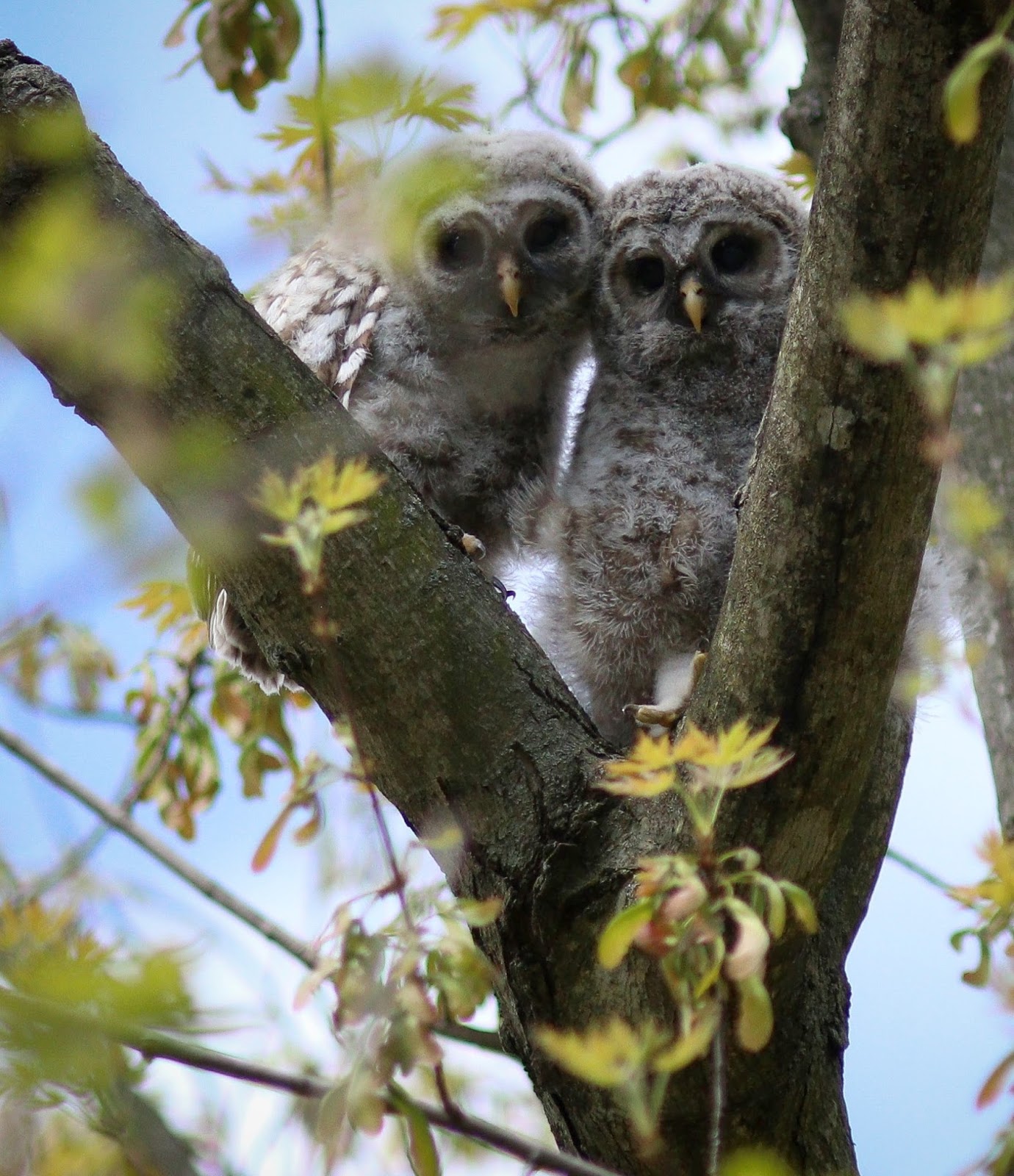
Thanks to bird-loving friends, John & Cathy, I was invited to check out the Barred Owl nest on their Mequon property.

Barred Owls are the ones whose call sounds like, "Who cooks for you?" Or, where I'm from, "Who cooks for y'all?" The "barred" name comes from their horizontally barred chest and their vertically streaked belly.


The nest was in a hole in a tree and two owlets were still in the nest; one was already out when I got there.


Mom was in a nearby tree watching over her kids.
I was able to catch a family shot later.  (Barred owls stay with mom for about 6 months or more until they go to trade school, marry or commit owl crimes and go to barred cells.)

One was ready to leave the nest in a few days.


 They have a sad visage and soft, brown eyes.


After  a few days passed, all of the owlets were out and it became harder and harder to locate them.
 I was fortunate to get these shots of Mom feeding one of the owlets. I think it was a chipmunk.


Today I was there and could only find one of the owlets alone on a high perch.


Maybe the mom is getting used to having me stalk them with my camera, because she didn't seem to mind when I spotted her on the ground, where she stared at me for a while and then flew deep into the woods where I lost sight of her.


 After a while, I saw her looking back at me.


 Barred Owls have perfect markings for hiding in the woods, where they swoop down on their prey in silent flight. Can you see her in this photo?


I suspect that in a few days I might not be able to spot the owlets because they'll start shedding their baby feathers and will be flying to other hiding places.


Wednesday, February 8, 2017

Bald Eagles 2017

I recently traveled to the Davenport, Iowa area to check out the winter arrival of Bald Eagles. During a stop at the Davenport Visitors Center, I learned that several eagles have been sighted at Lock & Dam #14 located in Pleasant Valley, Iowa about 10 miles from Davenport.

What a great tip! This location has a fairly large parking lot adjacent to the dam, a clean restroom facility, and, most importantly, a user-friendly boardwalk next to the water where there's room for many photographers to set up their gear with lots of space to share with others.

When my wife and I arrived, there were at least ten eagles in trees, waiting for the opportune time to hunt fish.

The first thing I noticed was this pair of eagles posing for us in a nearby tree. Eagles mate for life, and I imagined that this was a nesting pair either passing through or establishing a nest in the area.

And then the eagles started their hunt:


Luckily for us, a photographer had set up an ice chest loaded with dead fish.  Using a large syringe, he pumped a fish full of air so that the fish would float, enticing the eagles to leave their roost and make their strike for an easy meal.


Their accuracy was admirable, and they seldom missed the target.


One enterprising juvenile eagle caught the biggest fish, and it was not one of the dead ones.


These eagles were not bashful and were totally willing to fly close to the area where photographers gathered.


                       A juvenile and adult eagle performed their acrobatic flight in tandem for us.


I spent several hours at the dam and I met photographers from Illinois, Michigan and Georgia. I had great conversations with them about gear and techniques and I learned a lot, especially about wearing proper winter clothing. I had a lot to learn about that!

I encourage everyone to make the 3 1/2 hour trip to Davenport during the eagle season. You can stop for lunch at Flynnies Diner in Dixon, Illinois (free home-made warm cinnamon buns!) and also visit the house where Ronald Reagan grew up. Yahoo!


Friday, September 23, 2016

Egrets and Herons

Blue Herons, Green Herons and Great Egrets (White Herons) visit Wisconsin during the warm weather, and if you watch carefully you'll see that they are accomplished fish catchers. Most of the following photos were taken during July, August and September at Villa Grove (Mequon) and at the Thiensville Dam. A few pix (Night Heron and Blue Heron with nesting chicks) were taken at Greenfield Park in Greenfield.


                          This photo of a Blue Heron was taken at sunrise at the dam.


A Black-Capped Night Heron was spotted at the Greenfield Park coming in for a tree landing.


              In July, this Blue Heron was attending to its checks at a nest in Greenfield Park.

                                             Not the best looking kids I've seen, for sure!


A Great Egret lands at Villa Grove.
                             Another Egret joins it and they jostle to gain territorial advantage, but it looks more like a ballet than a fight. 


A Blue Heron already on the scene takes issue and the Egret flies away to a secluded part of the river.


                        Egrets are slow-moving and  patient while fishing but are rewarded often.


                  Blue Herons are equally adept at fishing and even large fish pose no problem.

        
  The Herons above and below took two fish while three fly-fishermen nearby never got a bite.


     Green Herons (below) are a smaller version of the larger Blue Herons but never failed to catch their limit.


Crayfish are easily snagged but the Green Heron had to work harder for frogs.

Sunrise is a great time to observe birds and other critters as they begin searching for food. And so what if you don't see any...you're enjoying the solitary, quiet beauty of Mother Nature.

Monday, June 27, 2016

Humpback Whales in Atlantic

In mid-June we traveled to Boston for a family function and then took a side trip to Plymouth, MA for some whale-watching and relaxation. This is the time of year when Humpbacks and their calves are feeding in Stellwagan Bank National Marine Sanctuary near Cape Cod Bay. It took about one hour for the Plymouth boat to reach the feeding area, but once we were there we were not disappointed.

The whales, several with calves, were feeding all around us. Locating a feeding whale was easy---all we had to do was look for the sea gulls hovering above the whales, hoping to snatch small fish that escaped the whale's mouth.


 Humpbacks are "baleen" whales, named for the long plates of baleen which hang in a row (like the teeth of a comb) from their upper jaws.  Baleen plates are strong and flexible; they are made of a protein similar to human fingernails. The whales blow bubbles underwater, forcing the krill and other small fish and plankton toward the surface. The whales then propel themselves to the surface with mouths open, swallowing water and fish and then "straining" the water through the baleen plates, leaving fish to be swallowed. This is much like the method I use to eat chowder.

The photo above is a close-up of the baleen structure of the whale's mouth and probably a good representation of the last thing Jonah saw during his biblical ocean journey.


 Taking photos of the whales was not without its challenges. By the time you see the whale and get to the correct area of the boat, the above photos are often what is captured.


 A calf came so close to our boat, the only photos I could take with my telephoto lens were of the blow hole.


Whales do not expel perfumed vapor from their blow holes. As you can see, this calf's spray was close to me and it smelled pretty bad, kind of like spoiled fish.

I went on three whale-watching trips in Plymouth, but only saw the feeding on the first trip. On the other two trips most of the whale activity was limited to occasional breaching, fin-slapping and diving, usually by the whale calves in the area. But it was a fantastic experience just being around these huge, graceful creatures. I recommend it.